Military Working Dogs
World War ZMilitary Working Dogs are not merely auxiliary animals in the war. They become a specialized military force whose senses, mobility, and bond with human handlers reshape how living units detect, lure, study, and destroy the undead. Their story moves from panic and biological instinct to rigorous training and tactical sophistication, while the losses suffered by handlers force the army to revise its own definition of a military unit.
Origins and Early Use
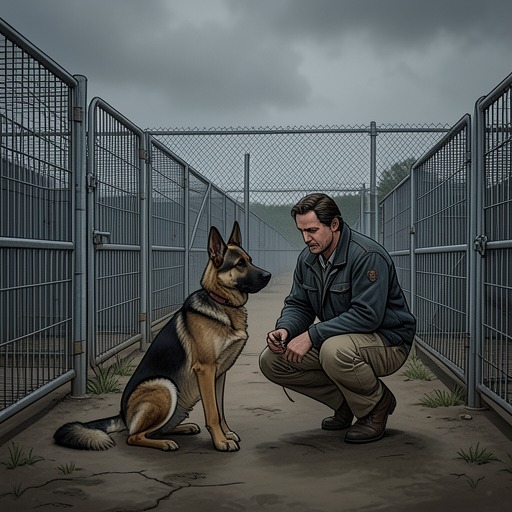
At the beginning of the crisis, the first major use of Military Working Dogs was triage. Dogs were trained to identify infected people by scent, and many countries copied the Israeli practice of sending individuals past dogs confined in cages. The cages were essential: an unconfined dog might attack the person being examined, another dog, or its own handler. The animals’ terror was involuntary, almost genetic, and could send even police and military dogs into uncontrollable violence. Handlers lost hands, arms, and throats, but the same fight-or-flight response that made the dogs dangerous also made them capable of detecting infection and probably saved millions of lives.
The program’s early logic treated canine fear as a resource to be exploited. Military planners initially recognized the dogs as sensitive biological instruments rather than as partners with their own limits. That distinction mattered because the animals were not simply following commands: they were reacting to a world saturated by the presence of the undead, and their bodies registered dangers long before ordinary human perception could do so.
Selection and Training
The American program attempted to go beyond exploiting terror by incorporating that instinct into regular military training. Its central principle was control. Puppies were introduced to the undead behind wire mesh, and instructors divided their reactions into two broad groups. Some whined or howled and lost control; others locked eyes with the subject, stood their ground, bared their teeth, and growled without surrendering to panic. The latter response became the foundation of the program. A dog’s ability to face the undead without becoming berserk was necessary, but it did not by itself make the animal controllable.
Basic training therefore tested physical endurance, obedience, intelligence, and discipline, alongside the handlers’ own training. The course followed the broad structure of the prewar program, but it was conducted jointly with the human recruits from the first day of Basic through ten additional weeks of Advanced Individual Training. Live Enemy Exercises were used to determine whether a dog and handler could function as a team under actual pressure. The process was costly: the washout rate reached 60 percent, and recruits, human and canine, could be badly injured or killed.
Breeding practices also changed. Purebred dogs were judged a complete failure for this purpose because aesthetic breeding had produced neurotic animals with too many health problems. The new generation was composed of mixed breeds selected for physical constitution and mental stability. The result was not a return to natural life but a deliberate wartime reshaping of the animal population, pairing inherited resilience with a carefully engineered military role.
Battlefield Roles and Tactics
The most recognizable missions were Lures and Decoys. In a Lure, the dog’s partner searched for the undead and led the subject toward a prepared firing line. Early teams ran in, barked, and fled toward the kill zone; experienced dogs learned to remain a few feet ahead, backing away slowly so that they could herd the maximum number of targets. In that form, the dog did not merely assist the tactic. The dog effectively determined when the shots could be taken.
A Decoy served a different timing function. If soldiers did not want the undead to arrive at a firing line too soon, a handler could circle the infested area and begin barking from the far side, redirecting the swarm. This method developed into the Lemming tactic during the Denver push. Several hundred reanimated refugees were trapped inside a tall building, and before infantry could storm the entrance, a Military Working Dog climbed onto the roof of a building across the street and barked. The undead followed upward, reached the roof, and spilled over the edge. After Denver, the tactic entered the formal playbook, and infantry used it even when no dog team was available, with soldiers sometimes standing on rooftops and calling toward nearby infested buildings.
Scouting was the primary and most common mission. In Sweep and Clear operations, a dog team attached to a conventional unit could detect a hidden undead creature miles before the soldiers reached it. The pitch of a growl and the frequency of a bark communicated the nature of the danger, while silence could be replaced by posture: the arch of the back and the raising of dander could reveal what the dog had found. Handlers learned to read these signals so precisely that a dog’s body became an operational report. Dogs locating an undead creature half-submerged in mud or lying legless among tall grass prevented ambushes and saved soldiers from attacks that might have torn off a foot.
Long Range Patrol extended this work beyond the army’s immediate lines. A dog could reconnoiter an infested area for days while wearing a harness equipped with a video uplink and GPS tracker. The system transmitted the number and position of targets in real time and allowed the dog’s location to be overlaid on an existing map. Later harnesses added radio uplinks through which handlers could relay orders or abort a mission, although teams had to be trained with the equipment from the beginning; seasoned dogs could not simply be retrained for a new system. The technology impressed military intelligence, but handlers experienced it differently, watching from safe, air-conditioned rooms while their partners faced the danger alone.
Packs, Escorts, and Ecological Danger
Long-range work was threatened not only by the undead but also by feral dogs. Pets and strays had degenerated into predatory packs, especially while moving through areas with low levels of infestation in search of food. Early Long Range Patrol missions were often aborted until escort dogs could be deployed. A patrol dog named by its handler as having two escorts, Pongo and Perdy, benefited from that protection; the escorts drove off feral packs fourteen times and engaged them directly twice. In one encounter, Perdy attacked a two-hundred-pound mastiff and crushed its skull in her jaws, the impact audible over the surveillance microphone.
The broader postwar ecology introduced another threat: F-lions, known informally as “Flies.” These creatures were described as cats resembling a mixture of mountain lion and Ice Age saber-toothed predator, roughly twice the size of a prewar domestic cat, with powerful teeth and claws and a strong appetite for warm blood. Their growth was associated with a transformed food chain in which rats had become abundant, fast, and intelligent scavengers living on corpses in trees and ruins. Animals capable of hunting those rats had to become still more formidable. For Military Working Dogs, the F-lions represented a danger that ordinary canine battlefield procedures could not easily answer.
Handlers, Sacrifice, and Institutional Change
The deepest cost of the program was emotional rather than logistical. A proposed explosive-dog project, unofficially called Fragmuts, nearly received approval after staff studied the use of “mine dogs” by the Russians during World War II. The program was abandoned partly because the strategic situation no longer seemed desperate enough and, according to the handler’s interpretation, because the army feared another Eckhart incident.
Sergeant Eckhart’s partner fell into a ditch during a Lure mission outside Little Rock and broke a leg while the swarm was only steps away. When an officer blocked her attempt to rescue the dog and cited regulations, Eckhart shot him. Military police restrained her while she listened to the undead surround her partner. She was later hanged in a high-profile public execution. The punishment reaffirmed military discipline, but the incident also exposed the moral impossibility of treating a bonded animal as replaceable equipment while demanding that its handler remain emotionally detached.
The rules changed afterward. Handlers were permitted to go after their partners even when doing so endangered their own lives. The army began to describe handlers and dogs as teams rather than as personnel attached to disposable machinery, and it tracked the suicides of handlers who lost their partners. Handlers had the highest suicide rate of any branch of the service, exceeding even Special Forces and Graves Registration. The same capacity for attachment that made them effective in combat made bereavement potentially unbearable. Their bond was therefore both the source of military success and the cause of exceptional psychological devastation.
Military Working Dogs also appear against the wider human machinery of wartime survival. Israeli medical examinations, civilian quarantine, labor classification, and military recruitment all turn bodies into objects of inspection and deployment; the dogs participate in that system by making infection legible through scent. Yet their use also unsettles the system’s categories. They cannot be reduced to instruments because their fear, judgment, endurance, and attachment continuously affect the course of operations. Their service demonstrates that the war was fought not only by human armies but by interspecies arrangements built under pressure, revised through catastrophe, and paid for in lives on both sides of the leash.
Legacy and Significance
The surviving account of Military Working Dogs is deliberately corrective. Popular memory may reduce canine service to a sentimental story about one dog rescuing one child, but the dogs’ contribution was broader: infection detection, reconnaissance, battlefield deception, target herding, concealed-enemy discovery, and long-range intelligence. Their work made invisible threats perceptible and converted instinct into coordinated action.
That achievement also carries a severe irony. The undead were not the only force remaking the animal world. Humans bred mixed-breed soldiers, confined dogs for medical screening, exposed them to live enemies, equipped them with cameras and trackers, and considered turning them into bombs. At the same time, feral packs and F-lions emerged from the collapse of ordinary ecological and social controls, while whales were hunted from converted fishing fleets and navies. Military Working Dogs thus stand at the center of the book’s multispecies history: they are trained collaborators in a human attempt to reclaim civilization, but their existence records the costs, compromises, and altered boundaries through which that reclamation became possible.